Pageviews last month

Tuesday, 10 October 2023

Another occasional wine blog

Maybe you could say we are too busy drinking wine to write about it - but now and then something pops up that is worth mentioning.

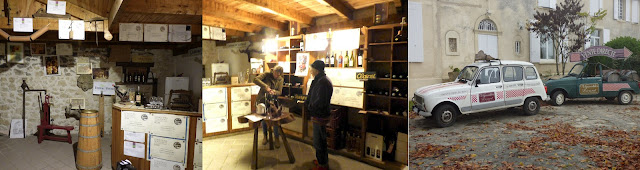
This time it is a visit to the Domaine de la Coste Moynier in what is now known as the commune of Entre Vignes, a picturesque new name   The Moynier family bought the domaine in Saint Christol in the 70s - we have met Luc Moynier and his wife a few times over the years - and it is now run by the younger generation.  The wines have always been good quality and not too expensive.

Alex and Judi (Kentuckians, though he now lives in Paris)
with friends Jim and Peggy also from the USA, in the new tasting room

Yesterday we tasted two whites, a rosé and 4 red wines, all excellent.  The whites were both mixtures of marsanne and viognier (the more expensive aged in barrels) while the reds were mixtures of syrah and grenache with, variously, carignan and mourvèdre added.

And the beautiful hilltop setting looking towards the Pic Saint Loup and the Cevennes made the whole visit even better in the beautiful sunshine.


Thursday, 3 August 2023

Wine chez nous this summer

This is just a round-up of the wines we've sampled over the summer so far.  Descriptions of many of them follow.

red wines


The 'Patrimoine' is a Marcillac from the high hills near Rodez in the centre of France, using little-known Fer savadou or Mansois grapes from that area.  Another central area for a new-ish appellation  is the Côteaux du Lyonnais, one of several (Beaujolais and nearby) using mostly gamay grapes - we spent a good couple of days visiting the area west of Lyon recently, and another wine in this collection is a Côte de Brouilly from one of our long-term favourite domaines, Les Roches Bleues.  A splendid Beaumes de Venise red came from the Domaine de Cassan where we stayed for Mary's 80th birthday, and the Cinabre red (Cabernet franc) is from a recent discovery from the Touraine which we visited with friends last year.  The same grape is used by the Domaine de Fadèze near Marseillan which we often visit - a warmer, more southerly take on this grape, one of many single-variety wines they make, including whites mentioned below, also including a good merlot also shown here.  Nearby, along the coast is the Domaine du Nouveau Monde, on the western edge of the Hérault, which we discovered during Mary's sojourn in Béziers in the early 2000s, still well worth a visit, while nearer Béziers if the Domaine de Bachellery, anotehr merlot here from a small old-fashioned family domaine who have a convenient shop outlet near the ring road!  Finally two the Spanish  discoveries I've mentioned previously in this blog, which we receive by road delivery rather than visiting the areas ourselves - a Montsant from a tiny hilly area south-west of Barcelona, one of my personal favourites; and the Pruno from the Ribera de Duero area further west towards the Portuguese border (I'm expecting another delivery of this today!

whites, rosés (and a couple of reds that crept in by mistake)

There are two old favourite producers here, the Domaine Lucien Jacob in the Hautes Côtes de Beaune whose white wine vinified in acacia barrels  is delicious, while their crémant de Bourgogne is our usual bubbly, while La Soie from the Chemin de Rêves (straddling the Pic Saint Loup and Grès de Montpellier areas is the top white from a domaine we discovered soon after our arrival in the Languedoc - the wine is made from a mixture of mainly northern Rhône grapes including marsanne, roussanne and viognier grown together on one plot.  More recent discoveries on our travels have been Seyssel in the Rhône valley much further north in the Ain, on the way to Geneva.  Roussanne also figures as another single variety wine from Fadèze, and viognier makes also not surprisingly a white wine in the Côteaux du Lyonnais, right next to Condrieu, its French area of origin.  For rosés these days we often drink the darker pink Protos and Enate rosado, both northern Spanish wines with very different origins tastes and grapes  - the Protos is mostly Tempranillo,  called Clarete which recalls the dark pink clairet wines of Bordeaux, while the Enate is made from cabernet sauvignon. The only sweet wine in this collection is from an old favourite appellation in Anjou, Bonnezeaux, a very long-keeping chenin blanc which has always given us enjoyment  Oh, and another Fadèze, our old favourite terret, the grape formerly used in apéritifs, but now working well in a dry white wine we and our friends have long appreciated  Happy drinking!

Thursday, 6 October 2022

Beaumes de Venise - A rather delayed wine blog


A good friend, not ignorant about wine, still associated Beaumes de Venise mainly with the sweet fortified muscat which we have also enjoyed for a long time.  Last month, however, our trip to the southern Rhône for Mary's 80th was all about the red wine from this part of the Dentelles de Montmirail, the wonderful rocky area which has long been famous for its red wines, notably Gigondas.

When we first visited the Domaine de Cassan around 25 years ago, its main attraction was red Gigondas.  Since then, as the separate appellation Beaumes de Venise has gained traction, Cassan has stopped making Gigondas and now produced excellent red Beaumes de Venise.  As se arrived (to stay in one of the few gîtes not taken up by young grape pickers) the harvest was just beginning.  The pickers were gathering as we finished our breakfast.


The little village of Beaumes de Venise is pleasant enough but not much to write home about.  but we love the Dentelles all around, accessible via narrow roads like the one we first came along to Cassan.  Then, it was a track which caused our engine to boil though thankfully nothing worse.  Now, that track (which our GPS still tried to send us up) is barred to motor vehicles, but other narrow roads still lead you to the Domaine de Coyeux and Domaine de Durban, neither of which we visited this time but both of which have excellent reds, and dry as well as sweet muscats.  Durban was our first ever foray into this wonderful area, with views over the whole of the Rhône plain to the west.  Coyeux has marvellous views of the Mont Ventoux which towers just to the south, and which has been the despair of many cyclists in the Tour de France.


Friday, 31 December 2021

Back to the Bordelais


Cadillac
 

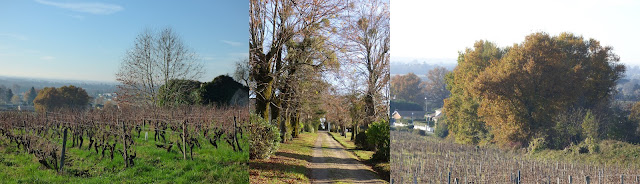
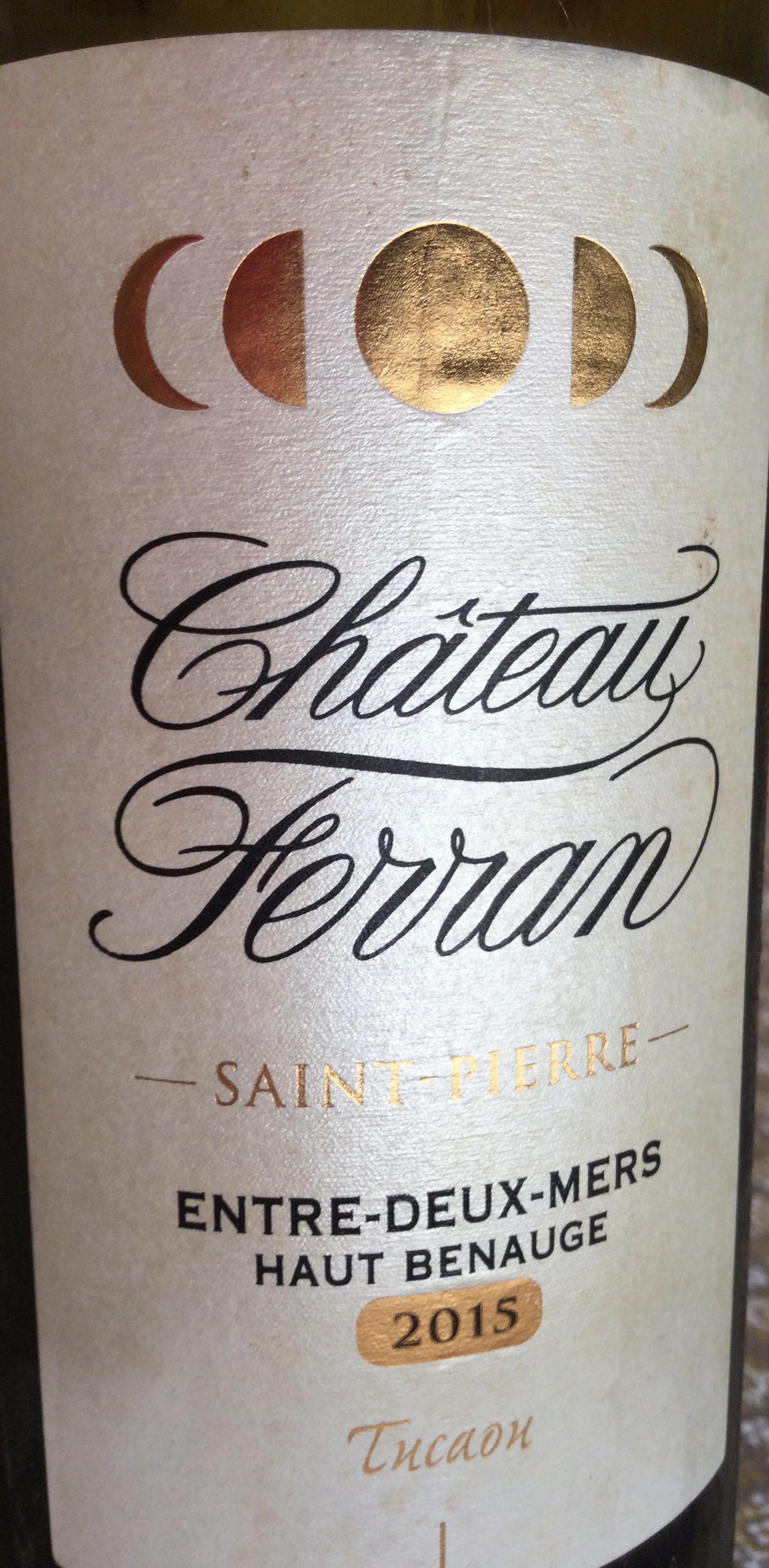
We'd been planning our late November mini break westwards for several weeks.  So at the end of the month we settled into our comfy hotel in Cadillac, after the first of 3 wine visits we'd planned. This was our first to the Entre Deux Mers area north of Langon.  I'd chosen from the Guide Hachette an old fashioned unpretentious château deep in the countryside near the tiny commune of Mourens, vines all around. Magnificent autumnal colours, staked vines across the rolling hillsides all around, a friendly welcome despite our lack of advance notice from the mum who showed us round and provided the wines for tasting, and her two winemaker sons who popped in and out to help it all along. And what wines! All at under 7€ a bottle, a sumptuous white Entre Deux Mers ‘haut Benauge’ and a very well-made red 2014 Bordeaux Supérieur. 

  
The following day, Wednesday was one of two contrasting but geographically closely linked visits to winemakers we’d met on previous occasions in the Bordelais. The morning we were in Ste Croix du Mont to meet Geneviève Ricard-Durand, who runs her old family vineyards, Vignobles Ricard,  with her husband. The Château de Vertheuil is one of 3 domaines they run, and though there are whites (dry and sweet), here it is the reds which are of special interest - the merlot-dominated Vertheuil was most appealing but we plan to contrast all 3 domaines in a future tasting. She also has a dark pink clairet we bought to try later : I really like this style of wine in the Bordelais, which we’ve found also from Spain’s Ribera del Duero region (as Clarete).  Although we had no time to visit them this time we had good memories of the incredible oyster shell cliffs in the village.

But in the afternoon it was the liquoreux (botrytised) whites at Clos Jean in nearby Loupiac which were stunningly presented by the proprietor (M Bord I think - the enterprices is certainly Vignobles Bord) a charming man whom we’d previously met in the Maison des Vins in Cadillac. The final tasting he offered us, not on sale, was a fabulous 60-year-old and amber coloured Loupiac which lingered long on the palate after our visit. We headed home with heads full of good memories and a car quite well stacked too!
 
  
 Several things struck us - first, the prices which were almost all modest (apart from the older sweet Loupiacs which rightly carry a higher price), far from the inflated ones Bordeaux often evokes.  Then, the lack of pretension and  the warmth of the welcome we had in all three domaines, all of which were family concerns.  And then the beautiful autumn colours all around, which I hope these photos convey.  After two wonderful days the rain set in as we drove back with a care well-stocked with the spoils of our trip.  We and many of the family have sampled these wines over the Christmas week.


Monday, 30 August 2021

New discoveries and old friends


At the Mas de Bellevue above Lunel to the north

I've nearly begun this post several times over the summer.  I do so now in memory of my recently deceased friend Alan Byars, married to Mary's cousin Barbara.  Although he made his money from another liquid, oil, this larger than life Texan shared my interest in wine and encouraged me to revive this blog when we met over good glasses whether in New Mexico or the Rhône valley.  He was an atypical American, (many I know don't even have passports) having lived and worked in Europe as well as in the US, and he and Barbara shared many holidays with us in England and in France as well as America.

Last time I wrote of our winter excursions into Spanish wines, and we have continued to enjoy the fruits of  our discovery of the Barcelona wine merchant Decántalo whose deliveries and service are very good.  Now I want to write a little about more local wines, which of course have been at the heart of our enjoyment of wine since our first excursions to France in the 1990s.   Our most recent discovery has been a wine truck, a motorised market stall that turns up at markets and evening events in Lunel and other local towns.  It's based near the Pic Saint Loup, one of our best-known local appellations, which can be seen (as here from the Mas de Bellevue) on the horizon from many places around here, and it's called Dégustez Sud, run by a nice couple who spend a lot of time picking out good wines from small producers across the area from Spanish border to the Rhône.  The wines are not necessarily cheap, but this is largely because smaller producers have higher overheads than larger-scale winemakers.

So far we have tried two whites, Folio, a grenache gris from Collioure near the Spanish border and a Mas d'Amile terret blanc, neither cheap but both out of the ordinary and enjoyable.  White wines can be more expensive than run-of-the-mill reds despite the generally shorter making time, because the process has to be cleaner and more temperature controlled.

Pleasant evening outings into Lunel to try wines from Dégustez Sud, the second with oysters for Mary!

Terret used to be a grape only used for fortified apéritif wines like Noilly Prat, but recently some delicious dry white wines have been made from this grape, and one from the Domaine de la Fadèze near Mèze has long been one of our favourites.  Interestingly, in a comparative tasting of that and the Amile wine the other day, we both preferred the cleaner, lemony Fadèze to the more recent discovery, and it has the benefit of being less than a third of the price, but that may be partly because we go to the producers for the Fadèze.  They make a range of red, white and rosé single-variety wines, all at very good prices.  

I'm ending with a few of the labels of recently enjoyed wines - 2 from the Rhône valley, a 10-year-old Beaumes de Venise from the left bank of the Rhône, in perfect condition from Durban, one of the first producers we visited there and the other from the right bank, the newere additions to the Rhône area in the Gard, in fact near the Pont du Gard and so named Domaine de l'Aqueduc.   And 2 from the Rive droite of the Garonne, one of the good sweet wines opposite the great Sauternes châteaux, and a very good Entre Deux Mers white from our good friend Jérôme whom we met recently in the Drôme, another proof that good white wines can keep for several years.


Cheers!


Sunday, 28 March 2021

Spanish winter


My encounters with Spanish wines go back to my teens, when my father returned from holiday in Spain (with my mum of course, but I’m not sure if Pam and/or Tom went too) lugging on the train 12 bottles of Rioja.  We have carried many bottles in our car over the years, but on the train with all the suitcases too…  Only my Dad!

More recently it all started in the autumn when Mary sighed that she missed Fino sherry, and we both recalled our love of PX (short for Pedro Ximenes, a grape variety used for sweet fortified wines in southern Spain, and so used in blends with drier wines to make the ubiquitous 'cream sherries' well-known in the UK).  We first encountered 100% PX 20 years ago at Rick Stein’s Padstow restaurant when the dessert was simply vanilla ice cream with a schooner of PX poured over.  

So I hunted idly to try and satisfy Mary’s craving and came across the Barcelona wine merchant Decántalo .  They specialise in Spanish wines but a quick scan shows they have plenty from other countries too – it seems to me to be as reliable and well-organised as the UK Wine Society with the advantage for us that it is just down the road, not in what we have now sadly to think of as a foreign country!

On top of this, this wine merchant packs things in super-safe cartons – we've had one or two disasters with breakages in the past, but bottles really have a hard time getting broken in these deliveries.  We began before Christmas with Tio Pepe Palomino Fino and Gonzalez Byass Nectar PX, plus a couple of  unfortified wines.  One of the first of these we tried was Protos Clarete, a light red or dark pink from Ribera de Duero, an area now quite well-known, top centre/north Spain a bit SW of Rioja.  This reminds me of the light red clairet which is produced in Bordeaux and whose name of course links to the red clarets from there we all know and love.  But the dark pink, or light red, style is distinct there as it turns out to be in Spain.

We also tried 3 Muga Riojas (red, white and rosé), all of them very good – a friend who knows this whole field well says white Rioja is hard to find, and remembering Dad’s samples I was really interested in this – Oz Clarke says white Rioja is a bit of an afterthought, but we have really liked this Muga, so still have some bottles to enjoy!   We then spotted a Christmas offer of 18 different wines, all red,

·         6 from Ribera del Duero (see above – we have already enjoyed these, wines and makers included Juegabolos, Malleolus, Corimbo I, Pago de los Capellanes Reserva, Pícaro del Águila and Astrales);

·         6  from Priorat (wines and makers include Ferrer Bobet Vinyes Velles, Salanques, Laurel, Mas d'en Compte Negre, Planetes de Nin, and Coma Vella) – we are halfway through these and have been so impressed by the  Ferrer Bobet that we have spent a small fortune on some of these bottles to lay down for the next few years;

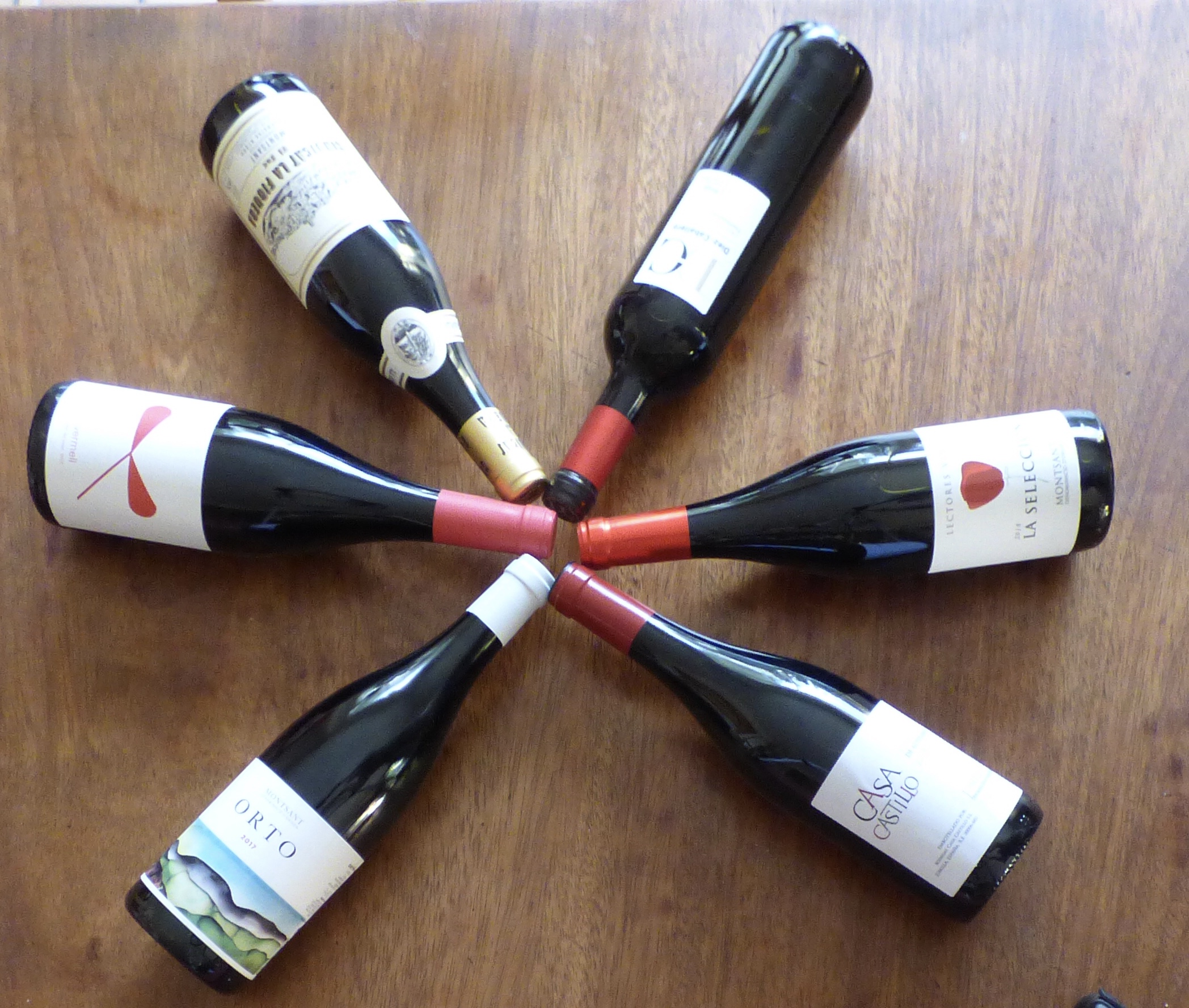
·         and 6 other reds, 3 from Montsant: (Fredi Torres Lectores Vini Montsant; Sindicat La Figuera; and Orto - we shared the  Figuera wine with friends yesterday and were very impressed), another Rioja: (Diez-Caballero Crianza 2018) and two from further south (Jumilla - SE Spain N of Murcia: Casa Castillo; and from Valencia: Parotet Vermell)

In the huge country of Spain and its many contrasting wine areas, I was surprised to find that two of these 3 appellations are tucked into a tiny hilly area SW of Barcelona: 

Priorat,  which according to Hugh Johnson's pocket guide produces some of Spain’s finest wines. It's named after a former monastery tucked under craggy cliffs. The key is the slate soil – known as llicorella. 

Montsant, tucked in around Priorat 

The thing to look forward to is a trip to these areas of Spain, relatively close to us although the travel complexities of travel with Covid, national restrictions and of course Brexit remain to be discovered! 

   I


Thursday, 10 September 2020

Condrieu


We have travelled past the precipitous vineyards south of Lyon often, and once we even bought excellent Condrieu at the Cave Coopérative of St Désirat.  We have also often bought and enjoyed viognier wines across the south of France and it is a scented grape variety often used in Rhône white wines with other grapes, as well as on its own.  But last week was the moment to enjoy a few sunny days in a riverside hotel and to visit the village and the vineyard which is the original home of the viognier grape.

There is an even tinier and more prestigious Appellation, Château Grillet, tucked in the middle of this hillside area (it has its own railway station just south of Condrieu), but the 'larger' Appellation is still small enough.  Its equally prestigious neighbour the Côte Rotie is on the riverside hills just to the north, between Condrieu and Lyon.  The makers we visited have some vineyards there and we came back with a few bottles of that iconic wine, almost 100% syrah but with a splash of viognier of course to add an exotic touch.


But the white wine, Condrieu, was our main focus on this trip.  Of course (as in most high profile areas) the less exalted wines are pretty good too.  We went  with a recommendation to a maker whose IGP viognier was recommended by a friend of a friend ad over the course of our stay in the hotel Bellevue in Les Roches de Condrieu (on the left bank facing the village of Condrieu and the vineyard hills behind) we drank glasses of this and of a late-picked viognier which was dark yellow and delicious.  

So we visited the Mouton winery on the hilltop settlement of Rozay high above the Rhône valley late one afternoon, just after they ahd returned from picking grapes for the day.  Of course we needed to make an appointment at this busy time of year, but we were received with warmth and courtesy, and we could taste both their IGP viognier and the 2 complex Condrieus, together with 2 Côte Rotie cuvées.   

The hillside vineyards in the photos are named Châtillon for one of the cuvées, facing the river.  We could see the vines from which one of our wines was made as we looked out of our bedroom windows or sat in the restaurant each day.  It was a memorable trip, and the wines will be with us to remind us for some time to come.