 Nearer to home the little village of St Christol is becoming well-known as a local centre of excellence. Winemakers like La Coste Moynier, Guinand, Hospitaliers and the Mas de Theyron all have a deserved, secure reputation, and the Cave Coopérative also makes good wines. A few years ago a project was launched to set up a centre for wine tourism (known as the "Pole Oenotouristique") which should be opening in the next year or so. This video shows what is planned.
Thursday, 28 July 2011
Some new links - local and global
I've just come across this blog written by a Frenchman, Claude Gilois, whose new book 'Tour du monde epicurien des vins insolites' has just been published. Living in London for some years he became aware of the availability of good wine worldwide, and returned to France determined to spread the message. French people in the past have known wbout the wines of their own area, and had little awareness of those from other parts of France, let alone other parts of Europe or the world. He finds unusual places and makers in France as well as around the rest of Europe and elsewhere in the world. If you can read French this blog, and the book, are well worth looking at.
 Nearer to home the little village of St Christol is becoming well-known as a local centre of excellence. Winemakers like La Coste Moynier, Guinand, Hospitaliers and the Mas de Theyron all have a deserved, secure reputation, and the Cave Coopérative also makes good wines. A few years ago a project was launched to set up a centre for wine tourism (known as the "Pole Oenotouristique") which should be opening in the next year or so. This video shows what is planned.


Friday, 1 July 2011

Tuesday, 7 June 2011
Favourites - Domaine les Roches Bleues
Côte de Brouilly (and Brouilly - both Beaujolais crûs) Christiane and Dominique Lacondemine run this family domaine on the southern slope of Mont Brouilly where the vines of the Côte de Brouilly appellation grow - the Brouilly vines grow on the plains surrounding the hill. The welcoming Lacondemines make just the two crû wines, and we met them through 3D wines who run the vineyard sharing scheme Jon joined in the early 1990s. Now we have moved on but we still visit this domaine regularly and are delighted to buy their wines. Both (like all red Beaujolais) are made from gamay grapes. The Brouilly is for fairly early drinking (2-3 years) while the Côte de Brouilly keeps rather longer. Incidentally there are 8 other Beaujolais crûs: Saint-Amour, Juliénas, Chénas, Moulin-à-Vent, Fleurie, Chiroubles Morgon and Régnié.
Domaine Les Roches Bleues, 69460 Odenas Phone 04 74 03 43 11
 Christiane and Dominique Lacondemine run this family domaine on the southern slope of Mont Brouilly where the vines of the Côte de Brouilly appellation grow - the Brouilly vines grow on the plains surrounding the hill. The welcoming Lacondemines make just the two crû wines, and we met them through 3D wines who run the vineyard sharing scheme Jon joined in the early 1990s. Now we have moved on but we still visit this domaine regularly and are delighted to buy their wines. Both (like all red Beaujolais) are made from gamay grapes. The Brouilly is for fairly early drinking (2-3 years) while the Côte de Brouilly keeps rather longer. Incidentally there are 8 other Beaujolais crûs: Saint-Amour, Juliénas, Chénas, Moulin-à-Vent, Fleurie, Chiroubles Morgon and Régnié.
A visit in 2006 (during our holiday in the Côte d’Or): It was a quiet, sunny drive down the motorway to Belleville, and we drifted on round Mont Brouilly to a warm welcome at Domaine les Roches Bleues, where Christiane Lacondemine (her husband is Dominique) showed us round. She was glad we'd come because she is uncertain of her English and was expecting new English 3D partners. We had a jolly tour of the old and newer vineyards, now being planted in wider and higher rows to facilitate cultivation. Inside, they were preparing for bottling the 2005, with huge heaps of bottles swaying across the yard in Dominique's strong arms, and the bottling lorry waiting in the road outside. We saw the insides of the barriques coated in sediment and tartar, which has to be scraped out by crawling inside - photos of D doing so were displayed. The tasting was wonderful, although the 02 and 03 which we tried for comparison showed how far the 04 we bought has to develop.
We visited again with friends Lilli & Per on a trip north from Lunel in March 2011. The wines were as good as ever, and the setting again lovely in the sunshine. Further details of this Burgundy trip in other posts over the weeks to come.
Monday, 30 May 2011
Favourites - the Chemin des Rêves, St Gély du Fesc
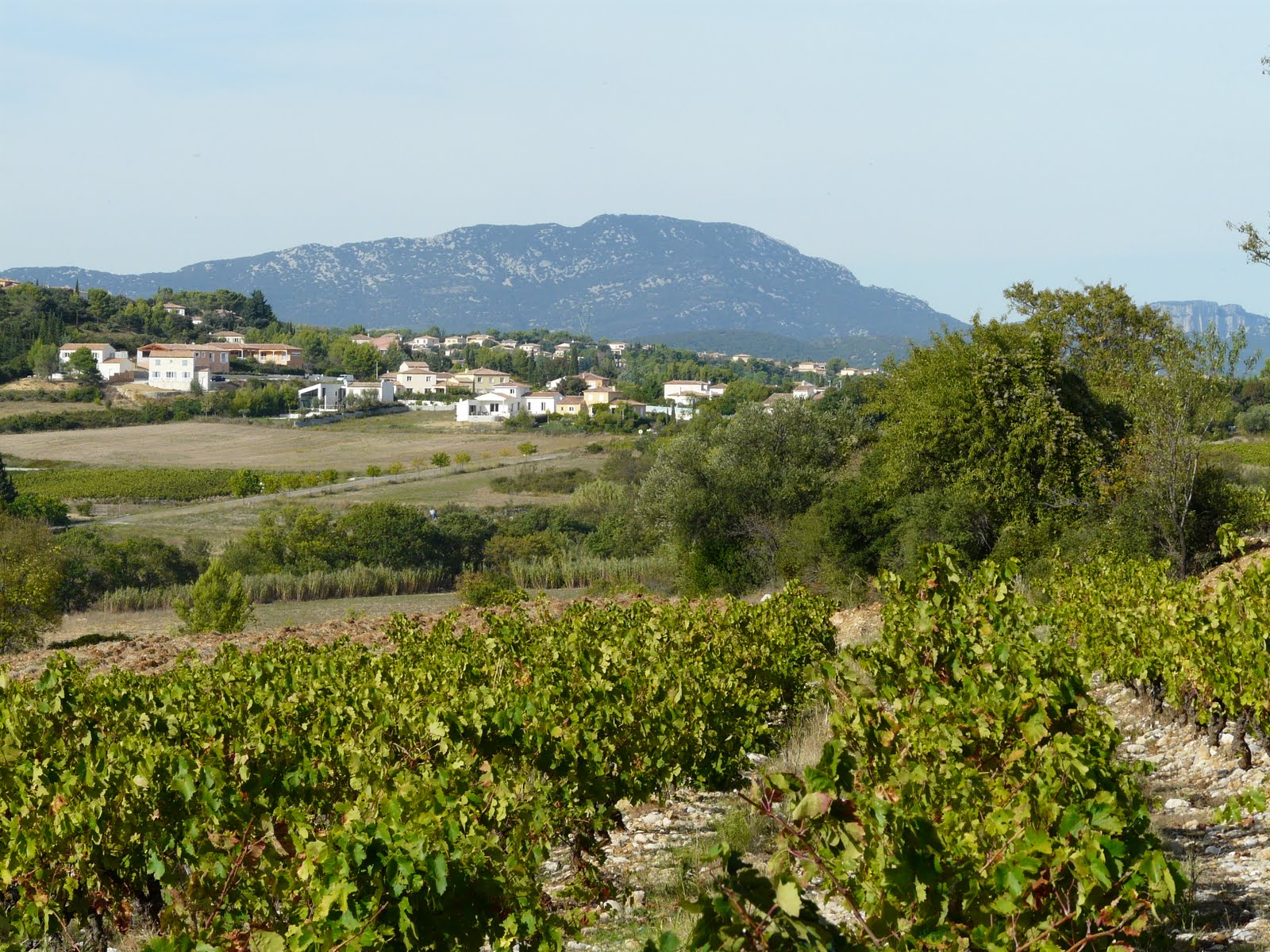 Early in our life in France we stumbled upon the Chemin des Rêves and the then new winemaker Benoit Viot. At that time he and his wife Servane and their children lived in Grabels north-west of Montpellier. Now he has acquired vines in the little village of Saint Gély du Fesc, a bit further north with a view across the vines to the Pic Saint Loup and the magnificent cliff face of l'Hortus. Here he has built the caveau and cave, and also their family home in the middle of the vines, all to the highest ecological standards. When I saw him today he told me that he'd just completed their large sheltered terrace. A perfect spot at the edge of a fast-expanding village.
Benoit used to work for Boots (pharmaceutical company and pharmacy chain) in England and Spain, and made his first wine (of which he is not proud!) from one of their kits while he was living in Nottingham. His fairly short English experience has left him with a useful command of the language, so if you don't speak French, don't be put off visiting him.
 His vineyards straddle the AOC areas of Pic Saint Loup and Grès de Montpellier. The name 'Chemin des Rêves' comes from the ancient footpath alongside one of hhis fist vineyards in the neighbouring village of Combaillaux. He makes excellent AOC wines including an inexpensive Côteaux du Languedoc called Bois-moi ('drink me' from the bottle of potion Alice used to change size in her adventures in Wonderland). Its lighter style reflects his love of his native Loire valley, and is unusual for a Languedoc red. Then there is a lovely trio of wines called Abracadbra - the red (one of my favourites today) and rosé are AOC Pic Saint Loup, as is the more sphisticated Gueule de Loup. But like many top winemakers in the Languedoc his most interesting wines are vins de pays, either because they include grape varieties such as cabernet sauvignon which are not in the Appellation Controlée regulations (Utopie 1, 2 and 3), or because they use a cobination of local varieities but in different proportions (The Saltimbanque is pure carignan).
 We first tasted his wine at our favourite retaurant l'Authentic in Lunel, whose owners share our enthusiasm for these wines. When I met him yesterday Benoit had just heard that he is invited to England in July among a small group of French winemakers selected by Jancis Robinson as examples of excellence. He deserves it!
Rue du Grand Plantier - 34980 Saint Gély du Fesc
(Postal address not yet on GPS: 218, rue de la Syrah )
Phone 04 99 62 74 25 • 06 85 73 29 33
Sunday, 15 May 2011
Italy - Friuli (2)
We decided to invite local wine-loving friends here in France to a tasting of the Italian wines we'd brought back in 2008-9. The wines were all made from single grape varieties from Friuli, almost all little-known outside the area. We asked everyone to bring something to share for the meal, trying to match each of the 6 wines we had chosen with a dish. All six wines were excellent, and each went well with its accompanying food.
For the apéritif we had the sweet but refreshing and slightly tannic white Verduzzo friuliano (Iacuzzi), then a fresh and lemony Tocai friuliano (Iacuzzi) with a light tuna and vegetable bake from one of our guests as the first entrée. The first of the reds, the Tazzelenghe (Iacuzzi) went with charcuterie - the wine is quite astringent at first taste, but as in the tasting we found the aftertaste wonderful and well-matched with the meats. The main course, a richly-flavoured rabbit casserole (from Elizabeth David's Italian food ) went with the second red, a Schioppetino (Iacuzzi) which had a delicious taste of sour cherries. The cheese included two or three Italian ones, with which we drank a refined and powerful refosco (Anna Berra).
Then the sweet, one of the elegant fruit tarts you can buy at almost any bakers', went with the dessert wine, a Ramondolo (Anna Berra) made from the same grape as the apéritif but is richer and more concentrated because the grapes are dried before the juice is extracted. In fact, we learned in Italy that the Tazzelenghe is also made with grapes left to dry for a month after picking - this is a common Italian practice for some of the great concentrated reds from other areas, but it was a surprise to find it used with a wine from such an obscure grape variety. The results, however, justify the effort we think: when we tried the rest of a bottle the day after the tasting it tasted even better.
I have mentioned the producers them in the previous entry with links their websites from which the last two wines came from. The first 4 were from the Iacuzzi brothers in Torreano, the final two from the Anna Berra vineyard a little further north in the hills of Nimis. I hope we can return and revisit both these excellent wineries.

Italy - Friuli (1)
Over the past few years we have visited the north east of Italy and the excellent but little-known wine area of Friuli several times. On our first visit, with our friends who have a house near Udine, we decided to explore the area just north of their village, and in the hamlet of Ramandolo we found the Anna Berra winery perched on a steep winding road with magnificent views across the vineyards and away to the south.

It was nearly 7 in the evening and we had no appointment, but we were greeted with enthusiasm and courtesy by the wine maker, Ivan Monai, who spent an hour with us in one of the best tastings I have ever experienced - 8 wines, each carefully presented from new bottles in glasses rinsed with each new wine before we tasted it. And they were great wines too - of the reds, the cabernet franc stood out for me, and there are also dry whites of which we liked both the friulani (grape variety also in the past confusingly known as tokai although it has little to do with the Hugarian grape) and pinot grigio.
But it was the 2 sweet wines made from late picked and for one wine partly-dried Verduzzo Friulano grapes that were really special. Ramondolo gives its name to one of these while the second, Anno Domini, the one from dried grapes, is fermented in oak barrels. We did not even taste the third sweet wine, Piccolit, also made from late picked and dried grapes, but we’ve since tried wines from this variety and from other producers and found them excellent.
Azienda Agricola Anna Berra, via Ramandolo 29 NIMIS - (UD) Italia tel. 0432 790 296 http://www.annaberra.it/

On a return visit we accompanied our friends to their nearest wine makers Sandro and Andrea Jacuzzi near Torreano. Again, we were very interested in local grape varieties although the makers often use internationally-known varieties like merlot, cabernet sauvignon, sauvignon blanc and pinot bianco too. This time we tasted 5 wines - 3 local reds made from schioppetino (grapes dried for a month before vinification) tazzelenghe (which means tingling tongue, in reference to the tannic 'buzz' of the first taste in the mouth) and refosco, and two whites, a dry tocai, and verduzzo (here used to make a semi-sweet and complex wine). All 5 were excellent in their way - the tastes lingered pleasantly in the mouth without unpleasant aftertastes, and demonstrated the potential of talented makers to rediscover old varieties and wines as well as using modern varieties well.
Azienda Agricola Iacuzzi, Viale Kennedy 35, 33040 Montina di Torreano (UD)
Tel. 0432 715147. http://www.jacuss.com/
Tel. 0432 715147. http://www.jacuss.com/
A brief mention here of a wine maker Livio Felluga whom we did not visit until a later visit, and whose wines are very good but pricey. They are reviewed in the British wine press more frequently than most other Friuli makers, and we confirmed their quality by sampling a bottle we were given. The website is good too!
Friday, 13 May 2011
Sweet wines
We are very fond of sweet wines. Often the word 'sweet' tells only part of the story - the best have aroma and freshness as well as more than usual sugar.
Mostly the sugar is the natural content of the grape juice. In most wine, all of it is turned into alcohol during fermentation. But in sweet wines, either fermentation is slowed down and stopped by cooling leaving some sugar, or alcohol is added to kill the yeast before all the sugar is used up, or sugar can be added to a dry wine - generally frowned on or prohibited, but it is allowed in Champagne.
In many cases, sweet wines are made by using riper than usual grapes - if they are late-picked they develop more sugar on the vine, and sometimes a special fungus - 'noble rot' - intensifies the sugar content still further.
There are costs and risks in using late-picked grapes - the weather has more chance to wreck a crop; riper grapes shrivel so you need more to get a given volume of juice; not all grapes on a bunch ripen at the same rate so you may need to hand-pick individual grapes (in French, vendanges passerillés); and if you wait for noble rot you sometimes get the wrong sort of fungus and the whole crop is ruined. So many sweet wines are relatively expensive.
Great sweet wines made from late-picked grapes include Sauternes and Barsac from Bordeaux, and many German wines from Riesling and other grape varieties. Some of our favourites from other parts of France are Coteaux du Layon and Bonnezeaux made of chenin blanc grapes, from the area south of Anjou in the lower Loire (these have astonishing keeping qualities for white wines and we have drunk 20- and 25-year-old examples which were delicious).
Closer to our new home and in the Rhône valley there are a number of well-known muscat vins doux naturels - the term is misleading since they are all made by stopping fermentation with alcohol, so are fortified like sherry or port. The best known of these is from Beaumes de Venise in the southern Rhône but Languedoc-Roussillon examples include Rivesaltes, St Jean de Minervois, Frontignan and our own local appellation, Muscat de Lunel.
Recently (July 2007) we have found wonderful sweet wines in Friuli in north-east Italy - Piccolit and Ramondolo are examples - and have realised that there are many wines in Italy like these which use late-picked grapes for sweetness but also enhance and concentrate them by partly drying the grapes before fermenting them. Obviously this produces still less wine from a given quantity of grapes!
Subscribe to:
Posts (Atom)